Do you want to know which digital marketing best practices for 2026 are actually worth your time and budget?
Good. Because a lot of the advice floating around right now is either painfully obvious or already out of touch with how digital marketing is changing.
Things are moving fast. AI is changing how people search for information. Social media algorithms keep evolving, and strategies that worked a few months ago may not perform the same way today.
Customers have changed too. They have more choices, more content competing for their attention, and more reasons to be skeptical of brands trying to sell to them.
Having a website and posting occasionally is no longer enough.
What matters now is understanding your audience, creating genuinely useful content, earning trust, making the customer journey as frictionless as possible, and continually improving your strategy based on what the data tells you.
In this guide, I cut through the noise and share digital marketing best practices for 2026 that work in practice. Not theory. Not wishful thinking. Practical strategies that can help you attract the right people, keep them engaged, turn more of them into customers, and grow your business this year.
No fluff. No outdated tactics. Just practical strategies you can put to work.
Let’s get into it.
1. Build Your Strategy Around Customer Intent
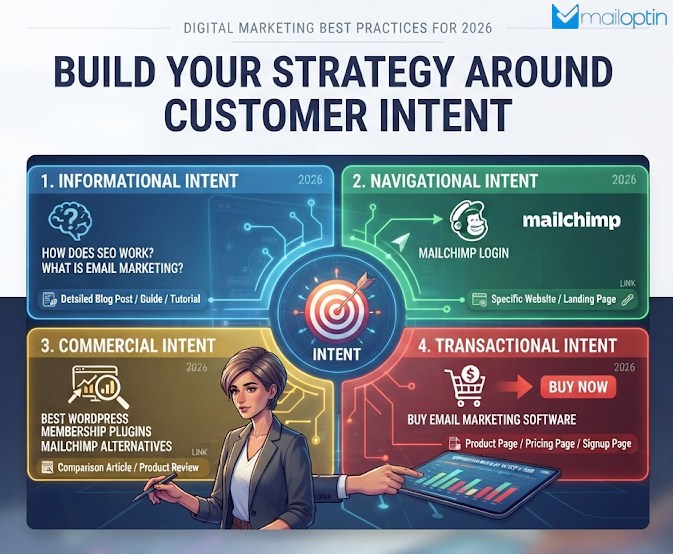
A successful digital marketing strategy starts with understanding what your audience actually wants. Customer intent refers to the reason behind a person’s search, click, website visit, or purchase. When you understand that reason, you can create content and campaigns that address their needs instead of sending them generic marketing messages.
For example, someone searching for “what is email marketing?” is probably trying to learn the basics. Someone searching for “best email marketing software for small businesses” is further along and may be comparing different options. A person searching for “buy email marketing software” may already be ready to make a purchase.
These people may be interested in the same general topic, but their needs are different. Treating them the same way can result in content that fails to answer their questions or guide them toward the next step.
Customer intent can generally be grouped into four categories:
- Informational intent: The person wants to learn something or find an answer. Searches such as “how does SEO work?” fall into this category.
- Navigational intent: The person is looking for a specific website, company, product, or page, such as “Mailchimp login.”
- Commercial intent: The person is researching options before making a purchase. Examples include “best WordPress membership plugins” or “Mailchimp alternatives.”
- Transactional intent: The person is ready to take an action, such as purchasing a product, signing up for a service, or booking an appointment.
Recognizing these intent types lets you create marketing content that fits where people are in their customer journey.
How to Do It
1. Research what your audience is searching for: Start by finding out what questions, problems, and topics matter to your target audience. Look at search queries, customer questions, support requests, social media discussions, reviews, and feedback.
Keyword research can also reveal the language people use when looking for information, comparing products, or preparing to buy. Pay attention to the words and phrases that indicate different levels of intent.
2. Identify the intent behind your target keywords: Don’t select keywords based only on search volume. Ask what someone is actually trying to accomplish when they use each search term.
For example, “how to improve website speed” has a different purpose from “best WordPress speed optimization plugin.” The first search suggests that the user wants to learn how to solve a problem, while the second suggests that they are researching a solution.
3. Create content that answers the specific need: Once you understand the intent behind a search, create content that gives the visitor what they are looking for.
If the intent is informational, focus on education and useful answers. If it is commercial, help the reader compare their options and understand the differences between them. If it is transactional, make the next action clear and easy to complete.
Avoid using every page to push a sale. Someone who is still researching a problem may not be ready to buy, and an aggressive sales message can make the content less useful.
2. Optimize for AI Search and Traditional SEO Together
Understanding customer intent tells you what your audience needs, but SEO determines how easily they can discover the content that meets those needs. Your digital marketing strategy should account for both traditional search results and AI-powered search experiences.
People still use search engines to find websites, articles, products, and services. Still, they increasingly interact with AI-powered search features that provide direct answers, summaries, recommendations, and links to relevant sources. This means your content needs to be useful and accessible across different search experiences.
The answer is not to abandon traditional SEO in favor of AI search. Instead, combine both approaches. Continue following sound SEO practices while creating content that is clear, well-organized, accurate, and easy for AI systems to understand.
For example, if you are writing about “how to choose a CRM for a small business,” don’t focus only on inserting the keyword throughout the article. Think about the questions someone with that search intent may have. They may want to know which CRM features matter, how much a CRM costs, whether they need one, and which options suit a small business.
Answering these questions in a clear and logical structure gives traditional search engines useful information to evaluate while also making it easier for AI-powered search systems to understand and extract relevant answers.
Below are a few steps you can take to implement this:
How to Do It
1. Research the questions behind your target keywords: Start by identifying what your audience wants to know, not just the keywords they type into a search engine. Look at related searches, search suggestions, customer questions, forums, reviews, and discussions to find recurring questions and problems.
2. Create content that directly answers those questions: Give clear answers to the questions your audience is asking. Start with the answer or main point, then provide additional explanation. This makes your content easier for people to scan and helps search systems understand the information on the page.
3. Structure your content clearly: Use descriptive H2 and H3 headings, short paragraphs, numbered steps, bullet points, tables where appropriate, and other formatting elements that make information easier to navigate. A clear structure helps readers find what they need without working through large blocks of text.
4. Continue applying traditional SEO practices: Optimize your title tags, meta descriptions, URLs, headings, images, internal links, and other on-page elements. Also make sure your website is crawlable, indexable, mobile-friendly, and technically sound.
5. Add original insights and useful examples: Give your content something that readers cannot easily get from dozens of similar pages. Include original research, practical examples, case studies, expert opinions, testing results, or firsthand experience when relevant.
6. Keep your content accurate and updated: Review content regularly, especially when covering software, pricing, statistics, features, regulations, or other information that can change. Updating outdated information helps ensure that visitors receive accurate answers.
3. Use AI as an Assistant, Not a Replacement
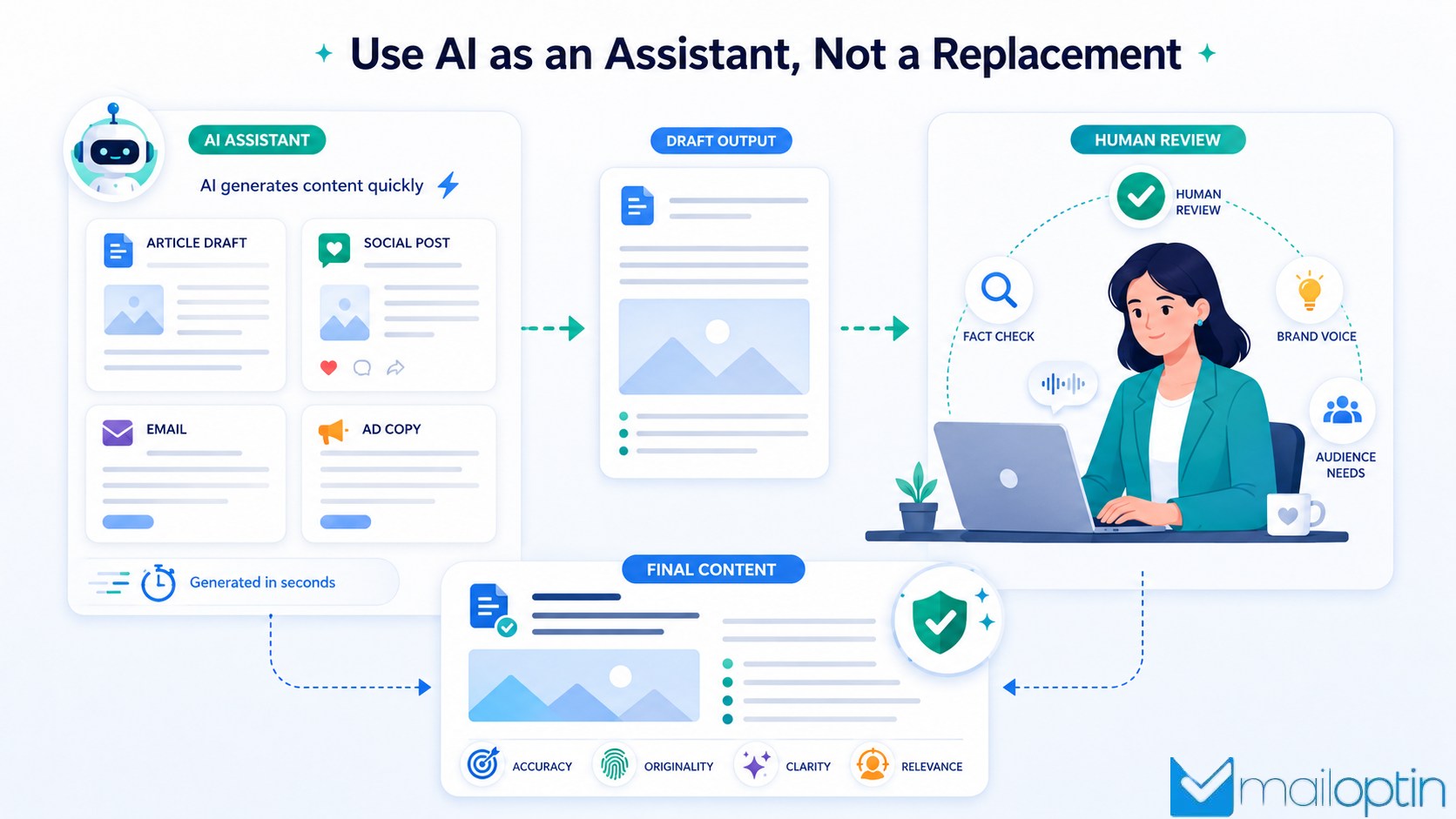
Optimizing your content for traditional search and AI-powered search matters, but how you create that content matters just as much.
AI can produce an article, social media post, email, or ad copy within seconds, but fast content isn’t automatically useful. It may lack personal experience, originality, context, or a clear understanding of what your audience actually needs. It can also produce inaccurate information, outdated claims, or generic wording.
This is why human involvement remains important. Use AI for time-saving tasks, but have a person review the output, add relevant insights, check facts, and ensure the final content reflects the brand’s voice and the audience’s needs.
4. Invest in First-Party Data Collection
First-party data is information people share directly with your business through interactions such as website visits, purchases, email subscriptions, surveys, account registrations, customer support conversations, and loyalty programs.
Unlike relying entirely on information collected by outside platforms, first-party data gives you a clearer picture of how your own audience behaves.
You can learn which products people are interested in, what content they engage with, how often they buy, which emails they respond to, and where they may be dropping out of the customer journey.
The important part is collecting this information responsibly.
Customers are unlikely to appreciate being asked for personal information without understanding why you need it. Give people a genuine reason to share their details, and be clear about how you’ll use that information.
How to Do It
Start with information that can genuinely improve the customer experience.
You might collect data through:
- Email and newsletter signups.
- Customer accounts and purchase histories.
- Surveys and feedback forms.
- Quizzes or product recommendation tools.
- Loyalty and rewards programs.
- Webinar, event, or resource registrations.
Avoid asking for ten pieces of information when two will do.
Then use what you collect to make your marketing more relevant. You could recommend related products, personalize emails, improve your content, create better audience segments, or identify where customers need more help.
5. Create Content That Proves Real Experience
In 2026, just explaining a topic is not always enough.
A lot of content already covers basic definitions, general tips, and recycled advice. What differentiates your content is showing it comes from real experience.
If you run a digital marketing agency, for example, do not stop at publishing another article explaining what SEO is. Share what happened during an actual campaign. Explain what you tried, what worked, what failed, and what you would do differently next time.
The same applies in other industries. A software company can show how customers use a feature to solve a specific problem. An ecommerce business can share lessons from product launches, customer questions, or experiments it has actually conducted.
Real examples make your content more useful and give readers a reason to trust what you are saying.
How to Do It
1. Share lessons from real projects: Use relevant experiences from your work to explain what happened, what you learned, and what others can take away from the experience.
For example, instead of writing general advice about improving email open rates, explain what you tested, what changed, and what the results taught you.
2. Include original examples: Create examples based on real situations your customers or business encounters. Explain the problem, the approach you took, and the result. If customer information is involved, remove or protect any confidential or personally identifiable details.
3. Show your process: Don’t only tell readers what they should do. Show them how you do it.
For example, if you recommend conducting keyword research, explain how you approach the research, what you look for, and how you decide which topics to prioritize. Screenshots, examples, and step-by-step explanations can make the advice more useful.
4. Use original data and research: If your business has access to useful data, consider turning it into content. This could include survey results, campaign performance, customer trends, testing results, or internal research. Original data can give your content a perspective you can’t get by copying information from other websites.
5. Address real customer questions: Review customer emails, support conversations, surveys, reviews, and sales questions to find recurring problems.
These questions can become content topics that directly address what your audience wants to know.
6. Include expert perspectives: When appropriate, interview people within your organization or industry and include their experience in your content. Ask specific questions that encourage practical answers rather than generic statements.
You can also explain who provided the insight and why their experience is relevant to the topic.
7. Be honest about what didn’t work: Experience is not only about sharing successful results. Explaining mistakes, failed experiments, unexpected results, and lessons learned can make your content more useful and believable.
For example, if a marketing campaign failed to produce the expected results, explain what happened and what you changed afterward. This gives readers practical lessons they can apply to their own work.
Creating content based on real experience helps your brand move beyond generic information. By combining first-party customer insights with firsthand knowledge, examples, research, and lessons learned, you can produce content that is useful, credible, and genuinely valuable to your audience.
6. Treat Social Platforms as Search Engines
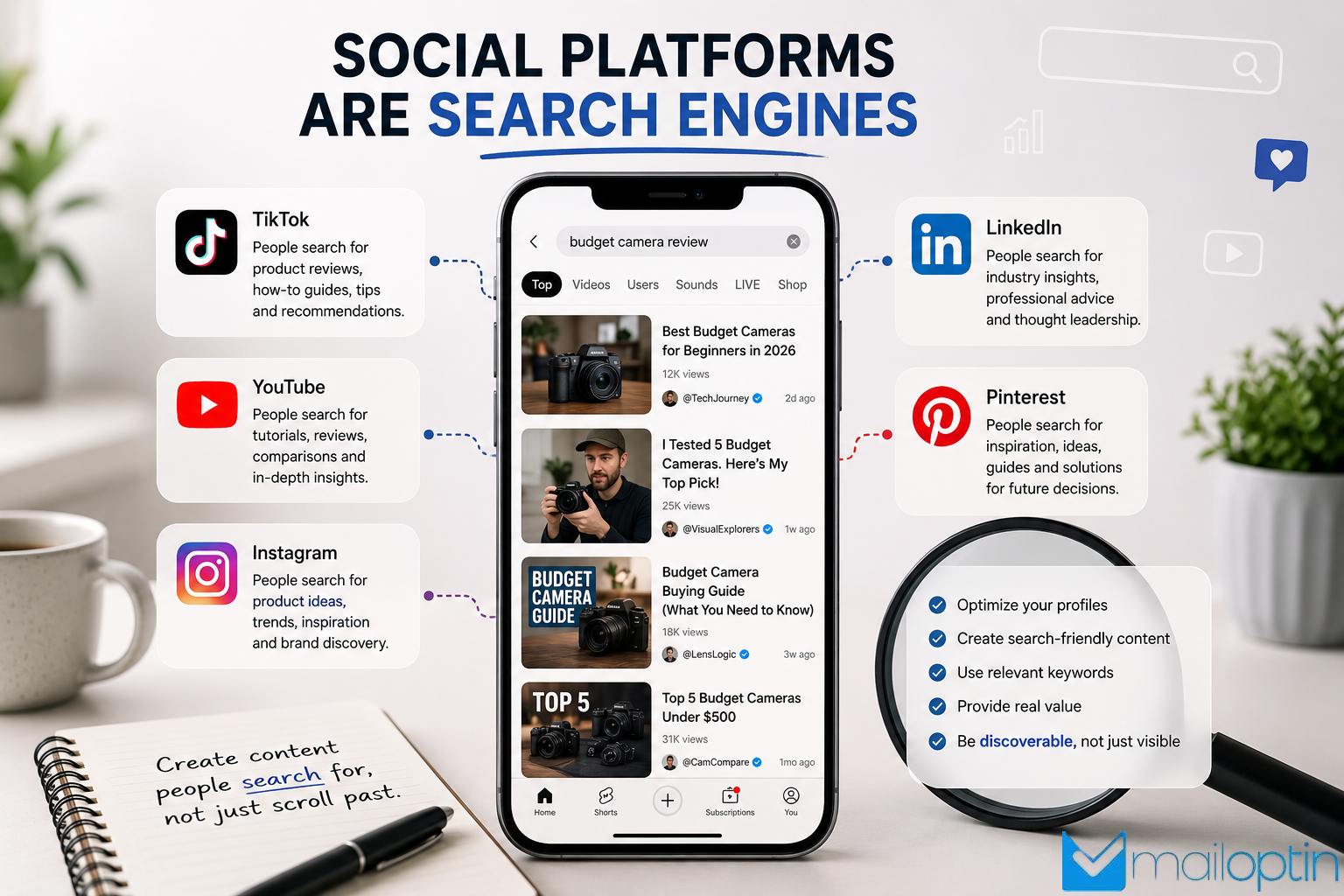
Social platforms have also become places where people search for information, products, recommendations, businesses, and solutions.
People search TikTok for product reviews, YouTube for tutorials, Instagram for product ideas, LinkedIn for professional advice, and Pinterest for inspiration. The type of information people look for varies by platform, but the underlying behavior is similar: they are using these platforms to find answers and discover content.
This means your social media strategy should focus on social search rather than only likes, shares, and follower counts.
Below are a few steps to implement this approach:
How to Do It
1. Research what people search for on each platform: Don’t assume that the keywords people use on Google are the same as those they use on social platforms. Search for your topics directly on platforms such as YouTube, TikTok, Instagram, LinkedIn, or Pinterest and look at the suggestions and results that appear.
Use these observations to identify questions, phrases, and topics that are relevant to your audience.
2. Use descriptive titles and captions: Tell people clearly what your content is about. Use relevant words naturally in video titles, post captions, descriptions, and other areas where they make sense.
Avoid vague captions that give users and search systems little information about the content.
3. Answer specific questions: Question-based content can work well for social search because it directly addresses what people are trying to find.
For example, instead of creating a general post about email marketing, you could create content around questions such as “How often should you send marketing emails?” or “How do you improve email open rates?”
4. Optimize your social profiles: Your profile can also appear when people search for businesses, professionals, products, and services. Clearly explain what your business does and include relevant terms that describe your products, services, or area of expertise.
Make sure your bio, business description, and other profile information accurately reflect what you offer.
5. Add context to videos and images: Don’t rely only on visuals to communicate your message. Where appropriate, use spoken explanations, captions, on-screen text, video titles, descriptions, and alt text to provide context.
This can help users understand your content even when they encounter it outside its original context.
6. Create content for each platform: Avoid publishing the same content everywhere without considering how people use each platform. detailed tutorial may work well on YouTube, while the same topic could become a short video, carousel, or concise post on another platform.
Keep the main idea consistent, but adapt the format and presentation to the platform.
7. Pay attention to social search behavior: Monitor the questions and phrases your audience uses in comments, direct messages, discussions, and searches. Look for recurring topics that could become future posts or videos.
7. Build an Excellent Email Program
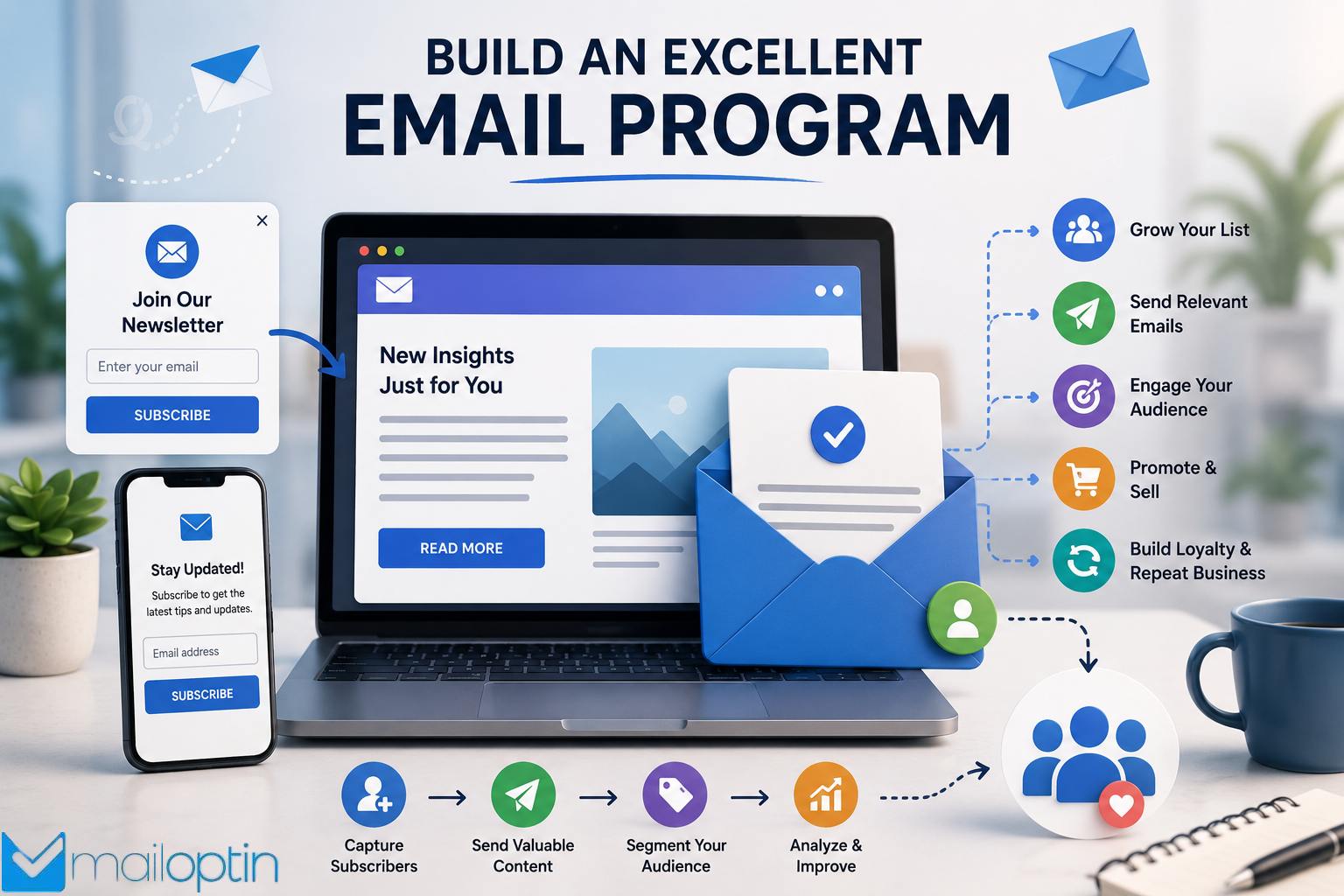
Email marketing gives you a direct channel for communicating with people who have shown interest in your brand. While social platforms can help you reach new audiences, your email list gives you a direct way to nurture relationships, share valuable content, promote your products or services, and encourage repeat business.
Your website should therefore make it easy for interested visitors to subscribe. You can use newsletter forms, popups, sidebar forms, in-content signup forms, notification bars, and other relevant calls to action to allow visitors to join your list.
For WordPress websites, MailOptin can help with this process. It lets you create opt-in forms and pop-up campaigns, and it also provides features for sending email newsletters. You can display signup forms in different areas of your website and use targeting options to show relevant messages based on factors such as the page a visitor is viewing or how they interact with your site.
Below are practical steps to take to build an excellent email program.
How to Do It
1. Give visitors a clear reason to subscribe: People are more likely to join your email list when they understand what they will receive. Offer something relevant, such as useful articles, exclusive content, product updates, discounts, or industry insights.
2. Add signup forms to relevant parts of your website: Don’t hide your newsletter signup on a single page. Consider placing opt-in forms in areas where visitors are already engaging with your content, such as blog posts, sidebars, landing pages, or other relevant sections.
On WordPress, MailOptin can create different opt-in formats, including lightbox popups, in-post forms, sidebar forms, notification bars, and slide-ins.
3. Use targeting instead of showing the same message to everyone: Different visitors may have different interests. Use page-level targeting and other relevant display conditions to show signup forms or calls to action that match the content a visitor is viewing.
For example, a visitor reading an article about email marketing could see an invitation to receive more email marketing resources rather than a generic message.
4. Send useful emails consistently: Give subscribers a reason to keep opening your emails. Share useful articles, practical advice, product information, industry updates, or other content that matches their interests.
If you publish regularly on WordPress, you can also use automated post notifications or email digests to keep subscribers updated when new content is available.
5. Connect your website with your email platform: Your signup forms should connect with the email marketing service or CRM you already use. MailOptin integrates with many popular email marketing and CRM platforms, allowing leads captured through your WordPress website to be passed to your preferred email system.
This helps keep your website signup process connected to the rest of your email marketing workflow.
6. Segment your subscribers: Use relevant information such as interests, customer status, purchases, membership, or engagement to create useful audience segments.
Sending more relevant messages can help prevent subscribers from receiving content that doesn’t apply to them.
7. Test your signup campaigns: Your email program begins before the first email is sent. Test different signup forms, headlines, calls to action, placements, and display conditions to see what generates more subscriptions.
MailOptin Premium also includes A/B testing for opt-in campaigns, allowing you to compare different versions and use the results to improve conversions.
8. Measure email performance: Track subscriber growth, clicks, conversions, unsubscribes, and other metrics that relate to your goals. Use the results to understand which content and campaigns are producing useful outcomes.
Don’t focus only on the size of your list. An engaged list of people who want to hear from your business is more valuable than a large list with little interaction.
8. Use Personalization With Respect for Privacy
A good email program helps you communicate with your audience regularly, but relevance is just as important as consistency. Personalization can make your marketing messages more useful by showing people content, products, and offers that match their interests. However, personalization should always be balanced with respect for privacy.
Customers are becoming more aware of how businesses collect and use their information. Seeing your name in an email is one thing, but receiving a message that uses personal information in an unexpected way can feel intrusive.
The goal of personalization should not be to use as much customer information as possible. Instead, use the information people have willingly provided or reasonably expect you to use to improve their experience.
How to Do It
1. Collect only relevant information: Don’t ask customers for information just because you can. Determine what information you actually need to provide a better experience and avoid collecting unnecessary personal details.
For example, a newsletter may only need an email address and content preferences.
2. Be clear about how data is used: Explain what information you collect, why you collect it, and how it will be used. Your privacy notice should be easy to find and written in language your audience can understand.
3. Give customers control: Allow people to manage their communication preferences where appropriate. They should be able to decide what types of emails or updates they want to receive and, where applicable, withdraw consent.
Giving customers control can help build trust and reduce unwanted communication.
4. Use first-party data responsibly: Use information customers have shared directly with your business to create relevant experiences. This could include their interests, purchase history, stated preferences, or interactions with your content.
Make sure the way you use this information matches what customers would reasonably expect.
5. Personalize based on context: Personalization works best when it has a clear purpose. Recommend related products after a purchase, send content based on selected interests, or provide information that relates to a customer’s current stage in the buying process.
Avoid adding personal details to a message to make it appear personalized.
6. Avoid excessive personalization: There is a point where personalization can become uncomfortable. Don’t reference sensitive or highly specific information unless there is a clear reason and an appropriate basis for doing so.
When in doubt, ask whether the personalization genuinely improves the customer’s experience.
7. Protect customer information: Use appropriate security practices to protect the information you collect. Limit access to customer data, review who can use it, and remove information that you no longer need when appropriate.
Also make sure your data practices comply with the privacy laws and regulations that apply to your business and audience.
8. Give personalization a clear purpose: Every piece of customer information you use should have a reason behind it. If using someone’s previous purchase history helps you recommend a useful product, it serves a purpose. If collecting additional information does not improve the customer experience, there may be little reason to collect it.
9. Diversify Where You Get Traffic
Here is a nightmare scenario every marketer wants to avoid. You build your entire business around one traffic source. Google sends you most of your visitors. You rank well, generate leads, and make sales. Everything seems to be working.
Then a major algorithm update changes your rankings. Your organic traffic drops, fewer people visit your website, and your leads and sales start falling with it.
The same risk exists with social media. Facebook can change how it distributes content. TikTok can change its features or policies. Instagram can adjust its algorithm, while LinkedIn can change how posts appear in users’ feeds.
You don’t control these platforms, and their changes can affect how many people see your content.
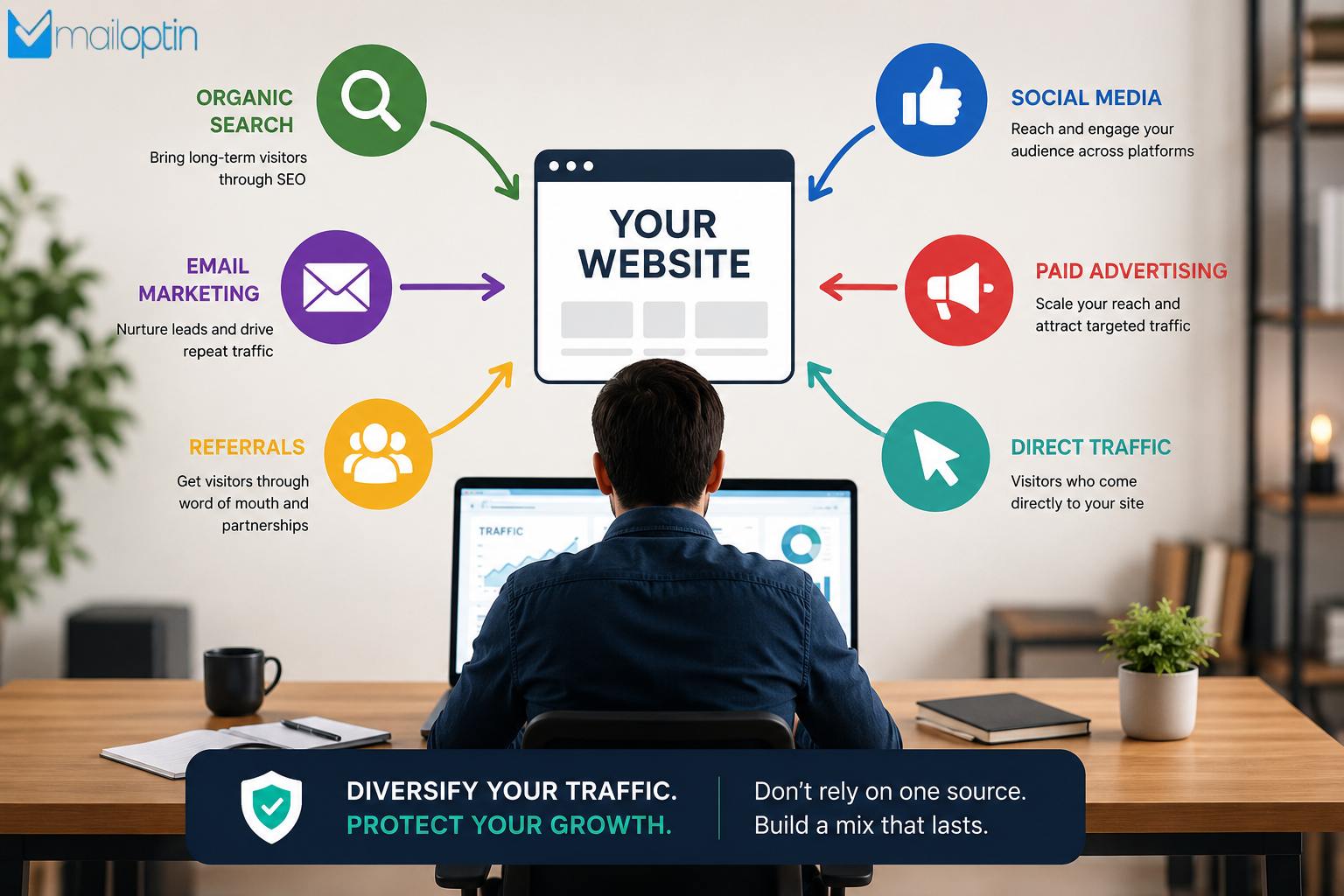
That is why relying too heavily on a single traffic source can put your business at risk. A better approach is to build a mix of traffic sources that can support your business even when one channel underperforms.
Your strategy could combine organic search, social media, email marketing, referrals, direct traffic, and paid advertising. You don’t need to use every available channel. Focus on the sources that make sense for your audience and business goals.
The goal is not to be everywhere. It is to avoid putting your entire growth strategy in the hands of a single platform.
Below are practical steps to help you diversify your traffic sources.
How to Do It
1. Identify your current traffic sources: Start by looking at where your website visitors currently come from. Check your analytics to see how much traffic comes from organic search, social media, email, referrals, paid advertising, direct visits, and other sources.
This gives you a clear picture of how much your business depends on a particular channel.
2. Identify opportunities beyond your biggest source: If a large percentage of your traffic comes from one channel, consider which other channels could realistically contribute to your growth.
For example, if organic search is your main source, you could develop your email list, improve your social media presence, build referral partnerships, or test paid campaigns.
3. Build your email audience: Email gives you a direct way to communicate with people who have already shown interest in your business. Use useful content, relevant offers, and consistent communication to encourage website visitors to subscribe.
This can reduce your dependence on algorithms and search rankings to reach people who already know your brand.
4. Repurpose useful content across channels: You don’t have to create completely new content for every channel. A detailed blog post can become a short video, social media post, email newsletter, infographic, or discussion topic.
Repurposing content can help you reach different audiences without starting from scratch each time.
5. Explore referral opportunities: Other websites, businesses, creators, industry publications, communities, and partners can introduce your brand to new audiences.
Look for relevant opportunities to contribute useful content, collaborate with complementary businesses, participate in industry discussions, or earn mentions from websites your audience already trusts.
6. Use paid advertising selectively: Paid advertising can provide another source of traffic when used carefully. Test channels that are relevant to your audience and start with a manageable budget.
Track results rather than assuming more ad spend will automatically produce better outcomes.
7. Measure the quality of each traffic source: Traffic volume is not the only thing that matters. Compare channels based on metrics such as engagement, leads, conversions, sales, and customer value.
A channel that sends fewer visitors but produces more customers may be more valuable than a channel that generates large amounts of low-quality traffic.
8. Review your traffic mix regularly: Your audience’s behavior can change over time, so review your traffic sources regularly. Look for sudden changes in performance and identify opportunities to strengthen channels that have growth potential.
The goal is not to be everywhere. It is to build a healthy mix of traffic sources that allows your business to reach its audience through different channels.
By combining search, social media, email, referrals, paid advertising, and other relevant sources, you can reduce your dependence on any single platform while creating more opportunities for people to discover and engage with your brand.
10. Actively Manage Your Reputation
People rarely make buying decisions without first checking what others have to say.
A potential customer may read your Google reviews, scan comments on social media, look at ratings on review platforms, or search for your brand before deciding whether to trust your business. What they find can either strengthen their confidence or give them a reason to look elsewhere.
That is why online reputation management has become an important part of digital marketing.
Make reputation management an ongoing part of your digital marketing practices. Pay attention to what customers are saying, respond to legitimate concerns, correct inaccurate information, encourage satisfied customers to leave honest feedback, and keep your business information consistent across the platforms where people may discover you.
How to Do It
1. Monitor what people are saying about your brand: Regularly check reviews, social media mentions, search results, forums, and relevant websites for conversations about your business.
You don’t need to monitor every corner of the internet. Focus on the platforms where your customers and industry audience are active.
2. Respond to reviews: Make a habit of responding to both positive and negative reviews. Thank customers for positive feedback and respond professionally when someone raises a concern.
Avoid arguing with customers publicly. If a problem requires private information, move the conversation to an appropriate private channel while still acknowledging the issue publicly.
3. Address genuine complaints: A negative review can reveal a real problem with your product, service, delivery process, or customer support. Instead of focusing only on removing the negative comment, look at what caused it.
If several customers complain about the same issue, use that feedback to identify what needs to change.
4. Encourage genuine customer reviews: Satisfied customers can provide valuable social proof. After a successful purchase or service experience, make it easy for customers to leave an honest review.
Don’t pressure customers to leave only positive reviews or create fake reviews. Authentic feedback is more valuable for building long-term trust.
5. Keep your business information accurate: Review your business information across your website, social profiles, business directories, and other relevant platforms.
Make sure details such as your business name, contact information, opening hours, services, and location are accurate and consistent.
6. Share positive customer experiences: With appropriate permission, turn genuine customer experiences into testimonials, case studies, or social media content.
Real examples can help potential customers understand what it is like to work with your business and can provide evidence beyond your own marketing claims.
7. Respond to misinformation carefully: Not every negative statement requires a response. However, if inaccurate information could seriously mislead potential customers, consider addressing it with clear and factual information.
Avoid turning the situation into a public argument. Keep your response professional and focus on providing accurate information.
8. Learn from customer feedback: Reputation management should not stop at responding to comments. Look for patterns in the feedback you receive.
If customers repeatedly mention the same problem or praise a particular part of your service, use that information to improve your business and your marketing.
A good online reputation is not created by deleting negative comments or publishing positive content alone. It comes from consistently delivering a good customer experience and paying attention to how people respond.
11. Keep Your Site Fast, Accessible, and Mobile-First
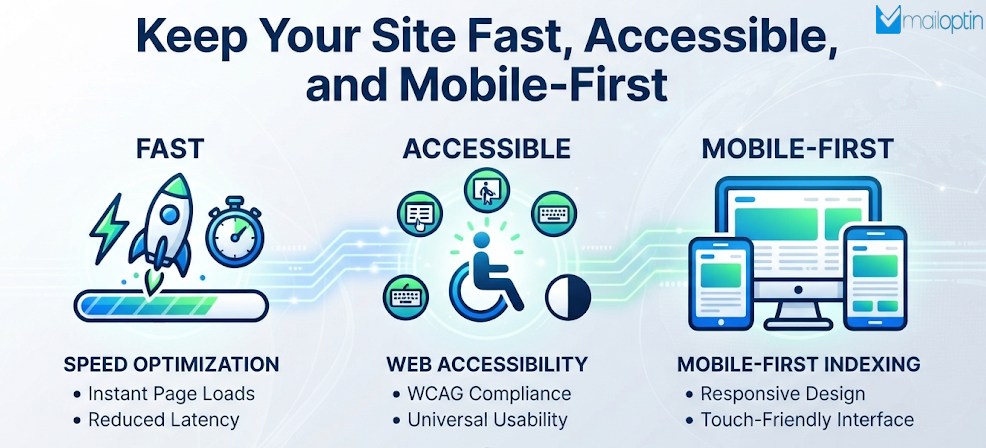
If your site loads slowly, is difficult to navigate, or works poorly on a phone, people may leave before they ever see what you have to offer.
That is why website performance is still an important digital marketing best practice in 2026.
Most visitors expect pages to load quickly and work smoothly on whatever device they are using. They also expect clear navigation, readable text, simple forms, and easy-to-tap buttons.
Accessibility matters too.
Your website should be usable by as many people as possible, including visitors who rely on screen readers, keyboard navigation, captions, or other assistive technologies. Making your site more accessible does not just improve usability; it can also create a better experience for everyone.
How to Do It
1. Test your website speed: You cannot fix what you do not measure.
Run your site through Google PageSpeed Insights. Free and easy. It gives you a score and specific recommendations.
Test on mobile and desktop. Mobile is more important.
Test regularly. Speed changes as you add new content and features.
2. Optimize your images: Large image files can make pages slower than necessary. Compress images before uploading them and use appropriate image formats and dimensions.
Avoid uploading images that are significantly larger than the space they will appear in.
3. Make your website mobile-first: Check how your pages look and function on smartphones and tablets. Make sure text is easy to read, buttons are easy to tap, forms work properly, and visitors don’t have to zoom or scroll horizontally to use the page.
Also test important actions such as purchasing a product, submitting a form, or completing a signup on a mobile device.
4. Improve website navigation: Visitors should be able to find important information without having to search through complicated menus. Use clear navigation labels and organize related pages logically.
A well-structured website also makes it easier for visitors to move from informational content to relevant products, services, or contact pages.
5. Make content accessible: Use descriptive headings, readable font sizes, meaningful link text, and alternative text for informative images. Make sure interactive elements can be used with a keyboard, and that important information is not communicated through color alone.
Consider accessibility throughout the design and content creation process rather than treating it as something to address later.
6. Reduce unnecessary website elements: Review your website regularly and remove plugins, scripts, widgets, images, and other elements that are no longer needed.
A website doesn’t need to include every available feature. Keep elements that serve a clear purpose for your visitors or business.
7. Test important pages regularly: Don’t assume that your website will continue working perfectly after it launches. Check important pages periodically, particularly after making major changes.
Test your homepage, landing pages, contact forms, checkout process, navigation, and other pages that directly affect conversions.
8. Monitor the user experience: Use analytics and website performance data to understand how visitors interact with your site. Look for pages with high exit rates, low engagement, or poor conversion rates.
Combine this data with customer feedback to identify areas that need improvement.
A fast, accessible, mobile-first website gives your digital marketing efforts a better place to work. Whether someone discovers your business through search, social media, email, or digital advertising, make sure the website experience that follows is easy, reliable, and worth their time.
12. Test, Learn, and Adapt Continuously
Platforms change. Algorithms shift. Customer behavior evolves. Competitors improve. What works well today may not deliver the same results a few months from now.
That is why one of the most important digital marketing practices is to keep learning.
An effective strategy is never truly finished. It should evolve as you gather more data, better understand your audience, and discover what actually drives results.
The goal is not to change things constantly for the sake of it. It is to test meaningful ideas, learn from the results, and use those insights to make better decisions.
How to Do It
1: Build Learning into Your Routine: Make learning non-negotiable. Schedule time each week to read industry news. Follow thought leaders. Study case studies.
Set aside time monthly to review your performance. What worked? What did not? What surprised you?
2: Stay Curious: Ask questions constantly. Why did this campaign perform better than that one? What changed with this platform? What are my customers talking about?
Curiosity drives discovery. Discovery drives improvement.
3: Listen to Your Customers: Your customers tell you everything you need to know. Read their reviews. Listen to their complaints. Pay attention to their questions.
They will tell you what they want. They will show you what is broken. They will reveal new opportunities.
4: Watch Your Competitors: Competitors are a free source of learning.
What are they doing? What seems to be working? What are they trying that you are not?
Do not copy them blindly. Learn from their successes and mistakes.
5: Test New Ideas Regularly: Keep experiments running. Try a new channel. Test a new format. Experiment with a new offer.
Not every test will succeed. But every test teaches you something.
6: Document What You Learn: Write everything down. What worked. What did not. What surprised you. What you want to try next.
Documentation builds institutional knowledge. It helps your team learn faster.
7: Share Learnings with Your Team: Learning multiplies when shared.
Discuss test results in team meetings. Share insights from customer feedback. Debrief after every campaign.
A learning culture outperforms a culture of assumptions.
8: Keep Going: Adaptation is never done. There is no finish line. No final destination. No point where you are done learning.
The best marketers are always improving. Always growing. Always adapting.
That is how you win in 2026. And beyond.
Frequently Asked Questions About Digital Marketing Best Practices
Q1. What are digital marketing best practices?
Digital marketing best practices are proven strategies and tactics that consistently deliver results. They are not guesses or trends. They are methods tested across industries and channels that reliably attract, engage, and convert customers.
Q2. Why are digital marketing best practices important?
Following sound digital marketing practices gives your marketing activities a clear direction. Instead of creating content, running advertisements, or posting on social media without a defined purpose, you can build your strategy around what your audience needs and how different channels contribute to your goals.
These practices can also help you use your marketing budget more effectively, understand customer behavior, improve the user experience, and identify areas that need improvement.
Q3. What is the best practice for digital marketing in 2026?
There is no single best practice digital marketing strategy that works for every business. But if I had to pick one that underpins everything else, it is this. Build everything around customer intent.
Know what your audience wants at each stage of their journey. Create content that answers their questions. Match your offers to their readiness to buy. Remove friction from every step. Every other practice in this article supports that core idea.
Q4. What is the most underrated digital marketing practice?
Email marketing.
Everyone chases social media trends and new platforms. Meanwhile, email quietly drives higher ROI than almost any other channel.
You own your email list. No algorithm controls your reach. No platform can take it away. You communicate directly with people who want to hear from you.
So build your email list aggressively.
Q5. How do I know which digital marketing practices to focus on?
Start with your business goals. For more traffic, focus on search and social discovery. For increased conversions, prioritize CRO and email marketing. To build trust, emphasize reputation and experience-based content.
Q6. What is the future of digital marketing?
More AI. More privacy. More personalization. More video. More voice search. More community.
But the fundamentals remain the same. Understand your customer. Create value. Build trust. Adapt constantly.
Q7. What should businesses measure in digital marketing?
Focus on metrics connected to business results, such as qualified leads, sales, conversion rates, customer acquisition cost, revenue, customer lifetime value, retention, and return on advertising spend.
Impressions, followers, and traffic can provide useful context, but they shouldn’t be treated as proof of business success on their own.
Conclusion
There you have it: digital marketing practices that can make a real difference in 2026.
These are practical approaches built around how people search for information, discover brands, consume content, and make purchasing decisions today.
You do not need to tackle all at once. That can quickly become overwhelming. Start with three that matter most for your business right now. Focus on doing them well, measure the results, and gradually add more as you go.
What matters is not trying to do everything at once. It is taking action, learning from the results, and continuing to improve.
So, choose where to start and take the first step today.